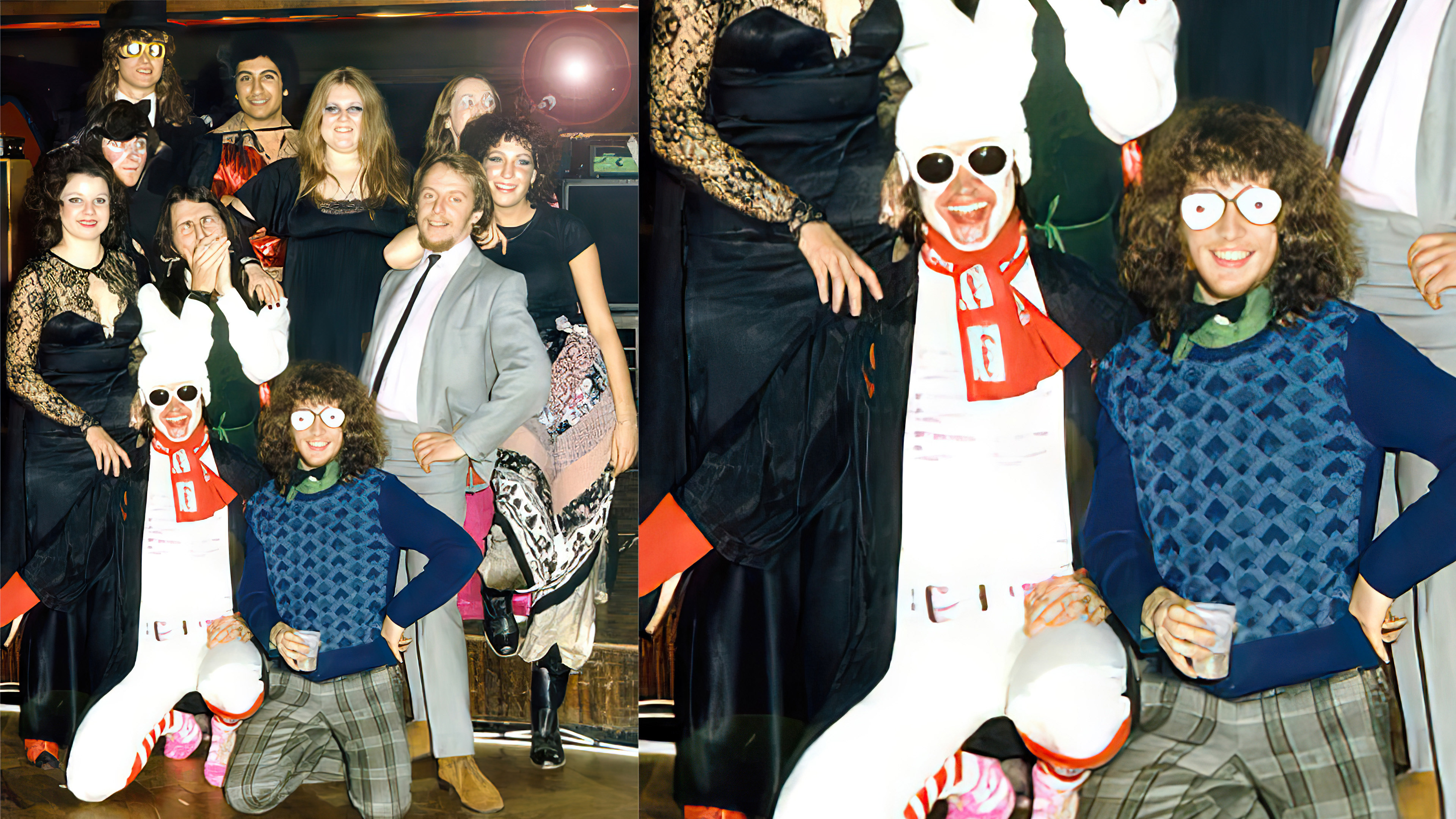
White Rabbit Show cast — 1975
The first ever student revue at La Trobe University
The first ever student revue at La Trobe University
How it all started...
La Trobe University first opened its doors in 1967 as the third university in Victoria, enrolling 552 students in its inaugural year. In the early days there were occasional student theatre productions from a small group called the Moat Players, but little else of note.
That changed in 1975, when La Trobe University Student Theatre was founded by Martin Edgar, Dave Armstrong and Terry Chapman. Their aim was to stage annual student revues made up entirely of self‑written sketch comedy. The first production, The White Rabbit Show, was performed at the Festival of Australian Student Theatre (FAST ’75) in Sydney and later at La Trobe University.
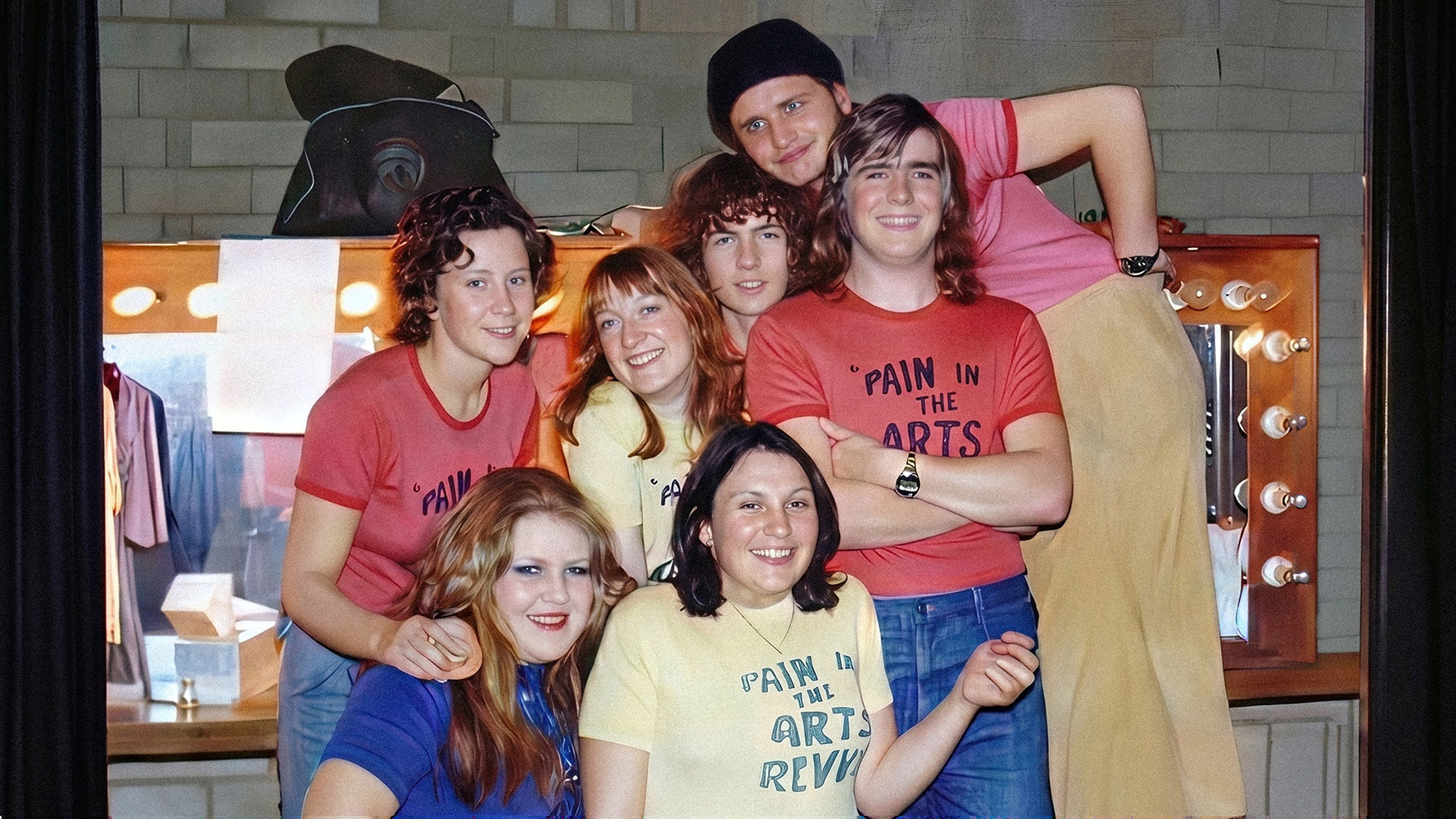
Pain in the Arts cast — 1976
The following year the group staged the successful A Pain in the Arts, which played to packed houses over four nights at the Menzies Theatre. Other cast members included Gair Cone, John Considine, Rafik Mankarious, Lloyd Smith, Merryn Baird, Judy Weintraub and Louise Ursic. (See full cast list here).
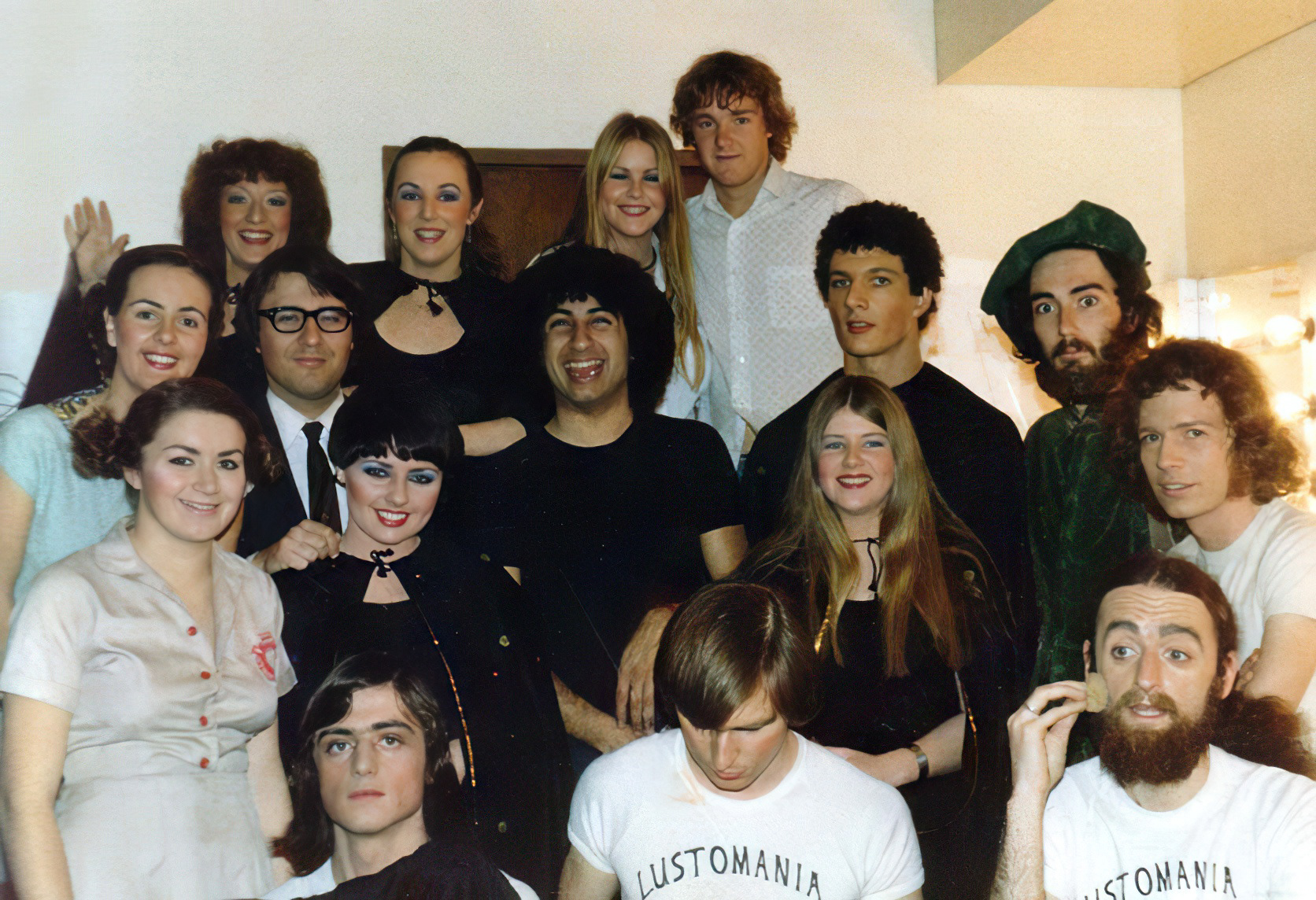
LUSTOMANIA CAST 1978
From 1975 through to 1983, La Trobe students wrote and performed annual revues at La Trobe.
Alongside comedy, They also staged several conventional plays. These included Alex Buzo’s innovative farce Coralie Landsdown Says No at the Menzies Theatre in 1976, followed in 1977 by Tom Cobb, which featured in its cast a young Jim Penman — later the founder of the Jim’s Mowing franchise.
Other productions followed, including a children’s show that toured primary schools in Melbourne and Sydney, with Kaye Sutton in the lead role as a princess who rids the world of bad people and dispenses snacks.
In 1978, an ancient Greek play was staged in the newly constructed Moat Theatre, designed in the style of a classical amphitheatre. Directed by Rafik Mankarious, it made full use of the theatre’s unusual circular setting.
Why the initial focus on comedy?
Why the initial focus on comedy?
Colour television arrived in Australia in 1975, and TV shows such as Monty Python’s Flying Circus and the ABC’s Aunty Jack Show had a huge influence on younger audiences.
At a time when colour TV was still a novelty, La Trobe student Lloyd Smith became an unlikely cultural hub. He had received an 18‑inch colour television as a birthday gift from a parent, and each week up to fifty students squeezed into his small Chisholm College room to watch Monty Python's Flying Circus — cheek‑by‑jowl, laughing themselves silly amid clouds of dope smoke, cheap wine and general conviviality. All crushed together in that tiny, airless room.
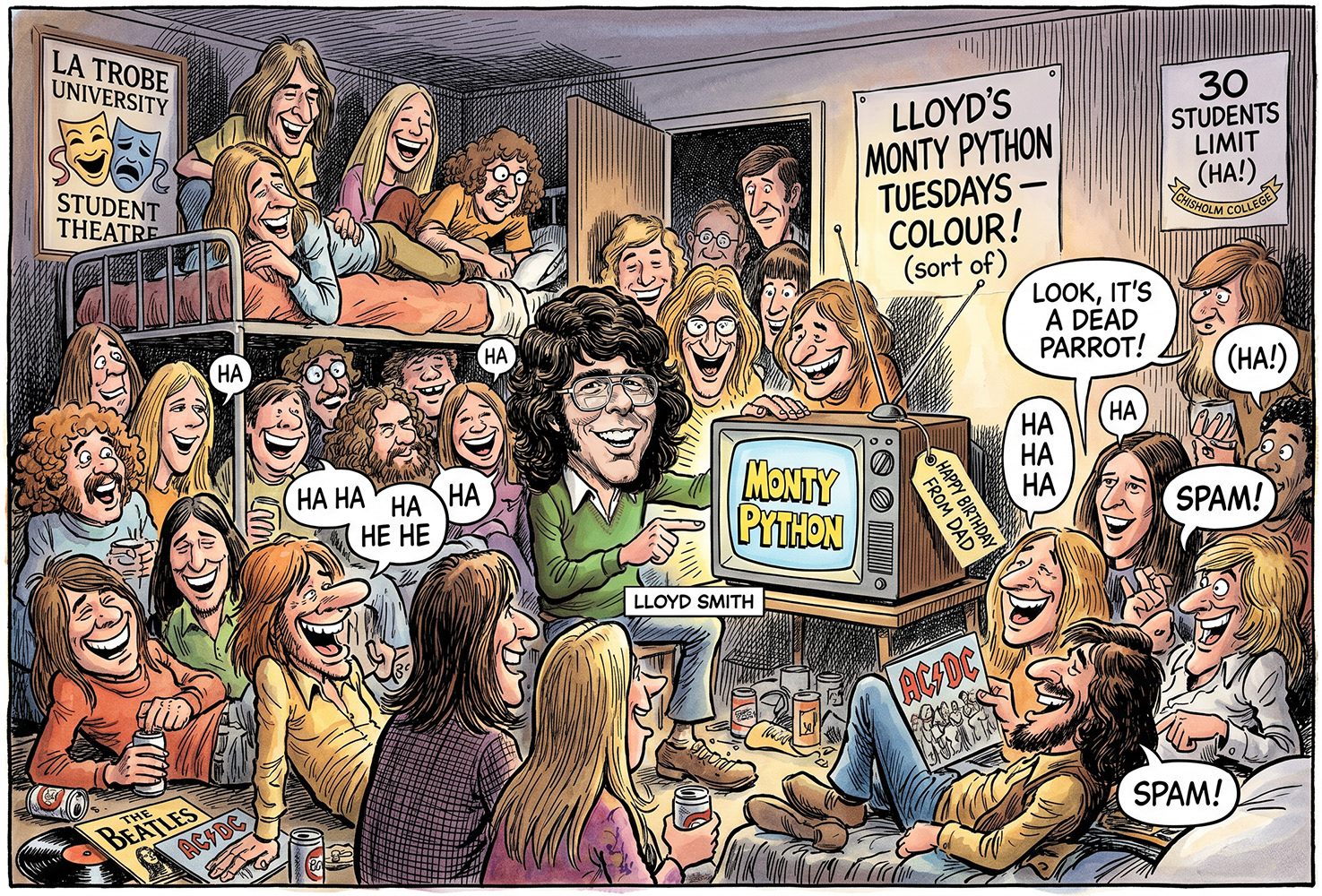
Lloyd Smith gets a color TV (Click to enlarge)
Student allowances were relatively easy to obtain, and the Student Representative Council (SRC) provided funding for clubs and societies. Many students took advantage of this support, and student theatre was one of the groups that prospered under the Whitlam government’s generosity.
To publicize the early revues, cast members appeared on the popular TV talent show New Faces. Three sketches were performed — one in 1976 and two the following year — and all three won their heats, giving the revues a significant boost in audience numbers.
The first sketch featured a middle‑aged couple glued to their television, speaking entirely in clichés from well‑known TV ads. At the end, the husband picked up a ukulele and the pair sang a song stitched together from advertising catchphrases familiar to every viewer of the time.
Another sketch had John Considine performing as a mad professor climbing out of a suitcase to deliver an unhinged rant. This followed an earlier sketch called Punctuation which had also been very successful.
Meanwhile, student theatre at La Trobe was expanding in other directions. The Voyage of U‑L‑C, produced by John Cheshire and written by Gary Sargent, was staged in the late 1970s. It broke new ground and became a standout success in the broader student theatre landscape.
Meanwhile, student theatre at La Trobe was expanding in other directions. The Voyage of U‑L‑C, produced by John Cheshire and written by Gary Sargent, was staged in the late 1970s. It broke new ground and became a standout success in the broader student theatre landscape.
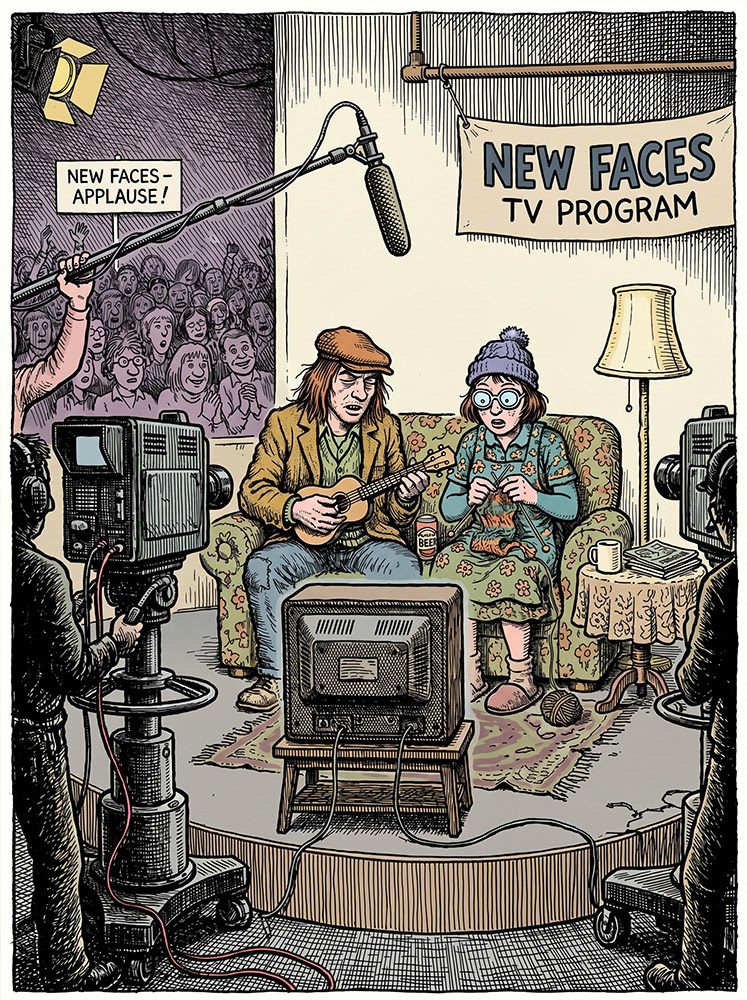
La Trobe students appear on 'New Faces' to promote the revue. (Click to enlarge)
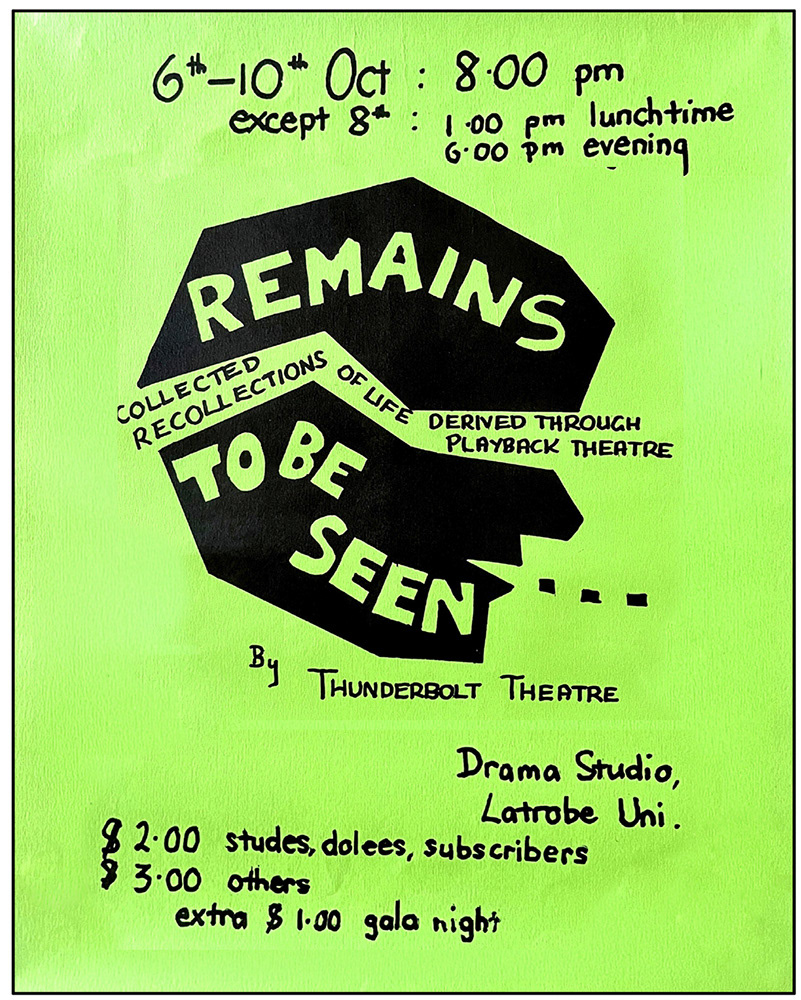
Thunderbolt Theatre
Simon Pryor, a stalwart of Melbourne University student theatre, was engaged by the Student Union to establish Thunderbolt Theatre, a new company focused on experimental work. It quickly took hold, broadening horizons and introducing new methodologies. Among the first intake were James Wishart, Sebastian Harvey, and two young students — Suzanne Kersten and Sue McClements — who would become key figures in La Trobe student theatre.
Thunderbolt’s first production was 'The Rock', a self-devised piece that Simon helped the cast develop from scratch. Sue and Suzanne, along with Glenn Filbin and Bev Nesbitt, showed just how powerful original theatre could be when they based their work on personal experiences. The result was the brilliant production 'FourPlay'.
Simon Pryor, a stalwart of Melbourne University student theatre, was engaged by the Student Union to establish Thunderbolt Theatre, a new company focused on experimental work. It quickly took hold, broadening horizons and introducing new methodologies. Among the first intake were James Wishart, Sebastian Harvey, and two young students — Suzanne Kersten and Sue McClements — who would become key figures in La Trobe student theatre.
Thunderbolt’s first production was 'The Rock', a self-devised piece that Simon helped the cast develop from scratch. Sue and Suzanne, along with Glenn Filbin and Bev Nesbitt, showed just how powerful original theatre could be when they based their work on personal experiences. The result was the brilliant production 'FourPlay'.
What came next?
1979 turned out to be a particularly significant year in the diversification of student theatre at La Trobe. This saw a variety of burgeoning student theatre productions at La Trobe including some from IDS Drama, a new course offered by the university that year. The festival also highlighted the productive partnership that had developed between the La Trobe Student Union and the wider student theatre community.
In 1979, the revue also received unexpected help from Cambridge University. Professor Mike Hodd, newly appointed to La Trobe, volunteered his expertise. A veteran of the Cambridge Footlights — the troupe that famously spawned Monty Python — he offered guidance on a bold new production. Unfortunately, he had to return to England before the work was completed.
1981 was a landmark year for the Union building, which hosted the Festival of Australian Student Theatre (FAST). Among those attending were Adelaide University’s Shaun Micallef and early members of Newcastle University’s Castanet Club — long before any of them became well‑known. Shaun slept on a humble foam mattress downstairs in the Union for the duration of the festival, along with his rowdy South Australian mates.
1979 turned out to be a particularly significant year in the diversification of student theatre at La Trobe. This saw a variety of burgeoning student theatre productions at La Trobe including some from IDS Drama, a new course offered by the university that year. The festival also highlighted the productive partnership that had developed between the La Trobe Student Union and the wider student theatre community.
In 1979, the revue also received unexpected help from Cambridge University. Professor Mike Hodd, newly appointed to La Trobe, volunteered his expertise. A veteran of the Cambridge Footlights — the troupe that famously spawned Monty Python — he offered guidance on a bold new production. Unfortunately, he had to return to England before the work was completed.
1981 was a landmark year for the Union building, which hosted the Festival of Australian Student Theatre (FAST). Among those attending were Adelaide University’s Shaun Micallef and early members of Newcastle University’s Castanet Club — long before any of them became well‑known. Shaun slept on a humble foam mattress downstairs in the Union for the duration of the festival, along with his rowdy South Australian mates.
The Student Union
Changes were also underway within the Student Union. Chris Brooking and Mike Lewis joined the Union Board, bringing with them a strong interest in supporting student theatre. Chris’s flair for publicity and pre‑sales helped increase revue audiences and revenue significantly.
Rob Wood, another stalwart of student theatre, became Union President, as had Mike Lewis and Rafik Mankarious before him. Rob was a welcome addition to the cast and later played a major role in the new Drama Department.
Student theatre could not have achieved what it did without the friendship and support of Mike Torney, manager of the Student Union. The Union — and Mike in particular — provided space, equipment, encouragement and practical help, enabling Thunderbolt Theatre to broaden their ambitions. His support was invaluable.
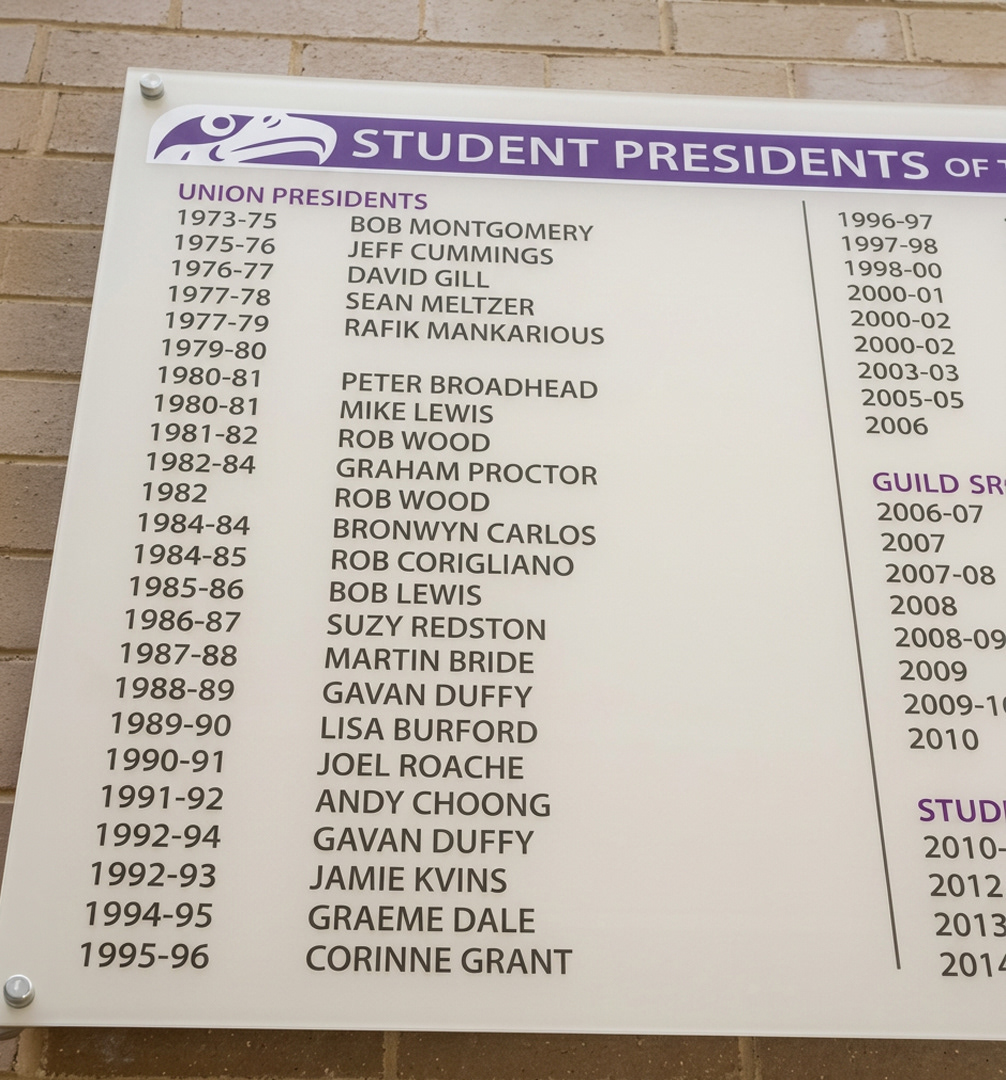
Student Presidents (Click to enlarge)
Orientation Day hijinks - Chris Brooking Memorial Lecture
Around this time, student theatre discovered a new way to promote its comedy: a bogus lecture on Orientation Day designed to attract both audiences and potential performers. Conceived the night before, Chris Brooking produced handbills using approximated academic names, warning students that missing the lecture would have dire consequences for their studies. It was billed as “An Event Not To Be Missed”.
Some academics tried, unsuccessfully, to keep students away. Once inside, first‑year students quickly realised the lecture was a spoof and the room erupted in laughter.
The following year the event returned, bigger than ever, under the title The Christopher Brooking Memorial Lecture — a tongue‑in‑cheek act of revenge. At the Union’s request, it ran annually for more than a decade. Comedy audiences rarely come better than wide‑eyed first‑years enjoying a send‑up of academia.